The fleet as a business, not a list of hardware
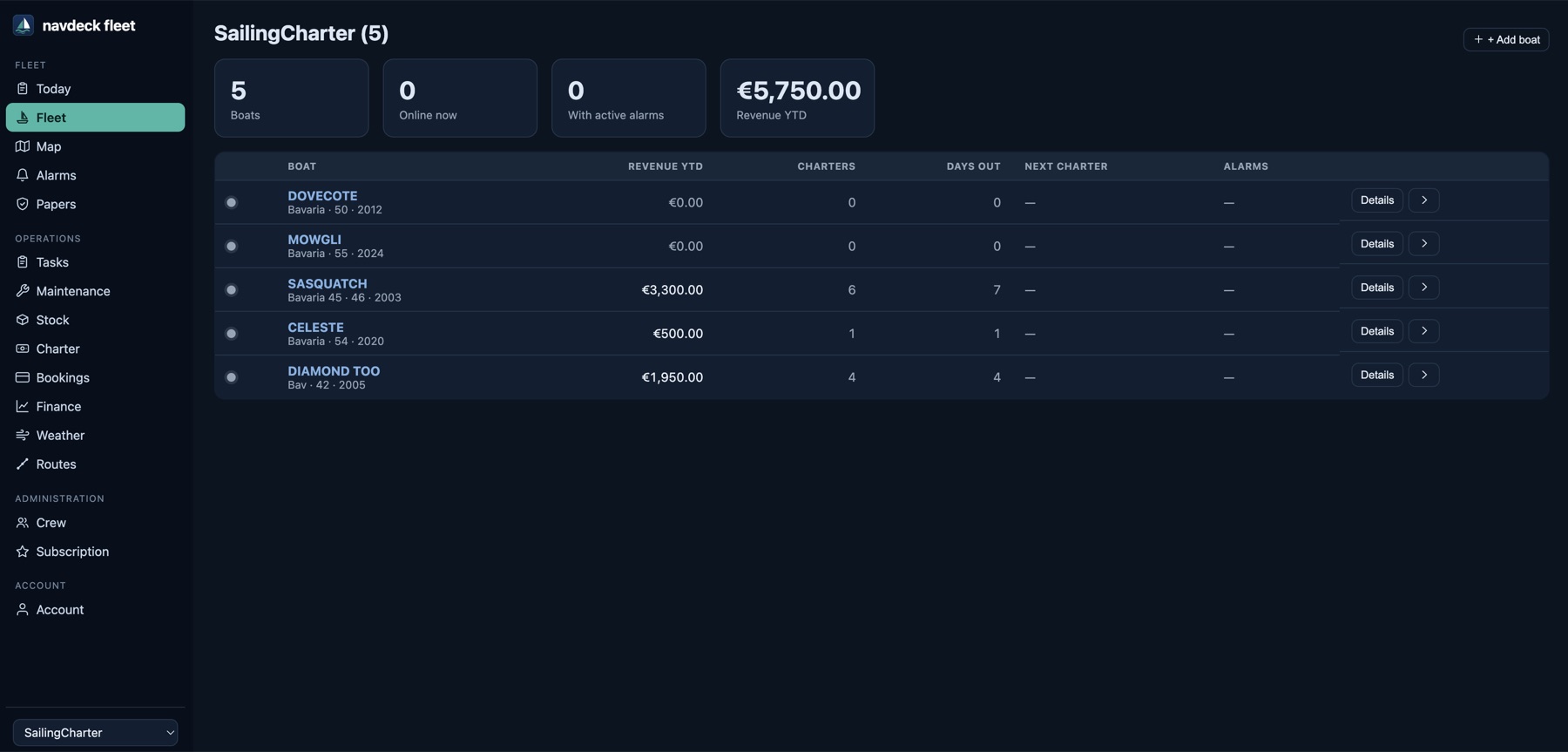
Revenue, charters and days out per hull — so you can see which boat earns its berth.
Charterunternehmen, Bootsclubs und Yachtmanager erhalten eine Live-Karte und ein Dashboard der gesamten Flotte — Position, Alarme, Batterien — plus echte Charter-Wirtschaftlichkeit: Fahrten als Einnahmen, Ausgaben als Kosten, Gewinn pro Boot. Eigentümer gewähren Ihrer Organisation Zugriff; Sie kommen niemals mit ihren Zugangsdaten in Kontakt.
Revenue, charters and days out per hull — so you can see which boat earns its berth.
Jedes Boot live auf einer Karte mit Alarm-Hervorhebung — klicken Sie auf einen Marker für den vollständigen Status.
Eine Statustabelle über alle Boote, die Sie besitzen oder verwalten, mit erweiterbaren Messwert-Chips pro Boot — eine Anfrage pro Aktualisierung, nicht eine pro Boot.
Eine einzige Alarmansicht über alle verwalteten Boote — erfahren Sie von der Bilgepumpe, bevor der Eigentümer anruft.
Protokollieren Sie jede Charterfahrt — Daten, Kunde, Gebühr — und das Einkommen des Boots baut sich von selbst auf.
Treibstoff, Verpflegung, Reinigung, Wartung, Liegeplatz, Crew — kategorisiert, pro Fahrt oder pro Boot.
Gewinn und Marge pro Boot und nach Ausgabenkategorie, damit Sie wissen, welches Boot wirklich Geld verdient.
Der Wartungsplan jedes Boots gruppiert und mit Fälligkeits-Markierung an einem Ort — auch für Boote, die eine Flotte nur verwaltet, nicht besitzt.
Nutzungsbasierte Erinnerungen verfolgen echte Telemetriedaten, keine Kalenderschätzung.
Arbeit protokollieren, Countdown zurücksetzen, weitermachen.
Ein Eigentümer gibt sein Boot auf der von ihm gewählten Sichtbarkeitsebene für Ihre Organisation frei — und kann dies jederzeit widerrufen.
Sichtbarkeitsbereiche (nur Position → operativ → vollständige Historie) werden bei jedem einzelnen Zugriff geprüft, nicht nur in der Oberfläche.
Eine Flotte, die Boote in Eigenbesitz hat, verwaltet sie auf dieselbe Weise, gleichrangig neben eigentümer-freigegebenen.
Your logo, your photo, your colour — and a link you can put in a social post. The customer picks a date and a departure without an account.
Ask for a percentage or a fixed amount to hold the boat, the rest on the day. The season's revenue still counts the full fee — a deposit is cash timing, not income.
Publish a charter that runs on whichever boat is free and big enough for the party. The customer sees which boat they would get; you stop maintaining one listing per hull.
Card payments go to your own Stripe account, never through ours. Refunds, balance links and payment checks are in the portal.
Branded, with the boat, the meeting point, an arrive-by time, what to bring, your cancellation policy and a calendar invite attached.
A booking nobody has replied to is a lost sale, not a late one — so it sits on the Today board until somebody deals with it.
Wind, gusts, waves and the exposed sector, per boat, against that charter's own hours. Two levels: warn the customer, or cancel.
No position, no forecast that far out, or a weather service that did not reply — all say so plainly. A charter we could not assess never shows green.
Roster skippers and hosts per charter, including freelancers with no account, and get hours and days per person per month — the number a pay run actually needs.
The twenty minutes between one customer leaving and the next arriving, on screen instead of on a printed sheet. A blocking line refuses sign-off and says which one.
Insurance, registration and survey across the whole fleet, sorted by what expires next — and boats with no dated papers at all listed separately, never quietly counted as fine.
Firing alarms, maintenance actually due, today's turnarounds, boats gone quiet and unanswered booking requests — one list, worst first, each row naming a boat and an action.
Tanks, power flow, engine and a compass rose per boat — the same panels myboat draws, so a manager and an owner are looking at the same thing.
The whole fleet's tracks on one map for a chosen window. Did that boat go where the booking said it would?
AIS targets near your boats, assembled from the platform's own feeds — you own no receiver and send nothing. Your own antenna, if you have one, simply makes it sharper.
A hull with no box aboard still appears on the map if AIS has seen her — marked as located rather than tracked, with the age of the fix written on the label.
The boat's manuals, papers and every job ever done on her, filed against the hull rather than against your company.
What is on the shelf and what still has to be done, per boat, so the turnaround is not a memory exercise.
Nein. Die meisten Flotten verwalten einen Mix — manche Boote besitzen sie selbst, andere werden von Eigentümern freigegeben, die eine „Verwalter“-Beziehung gewähren. Beide sehen im Dashboard gleich aus und funktionieren gleich.
Ein Eigentümer, der die kostenlose myboat-App nutzt, gibt sein Boot für die ID Ihrer Organisation frei und wählt eine Sichtbarkeitsebene — von nur Position bis zur vollständigen Telemetrie-Historie. Sie sehen niemals seine Zugangsdaten, und er kann den Zugriff jederzeit widerrufen.
Nein — sie ist im Fleet-Plan enthalten. Protokollieren Sie laufend die Einnahmen und Kosten einer Fahrt, und der Gewinn- & Margenbericht pro Boot baut sich von selbst auf.
Ihre Flotten- und Charterdaten lassen sich jederzeit exportieren. Wir glauben, dass das Gehen einfach sein sollte — das ist es, was das Bleiben sinnvoll macht.
Kostenlos, um eigene Boote hinzuzufügen. Wir betreuen jede Flotte persönlich — schreiben Sie uns jederzeit.