The fleet as a business, not a list of hardware
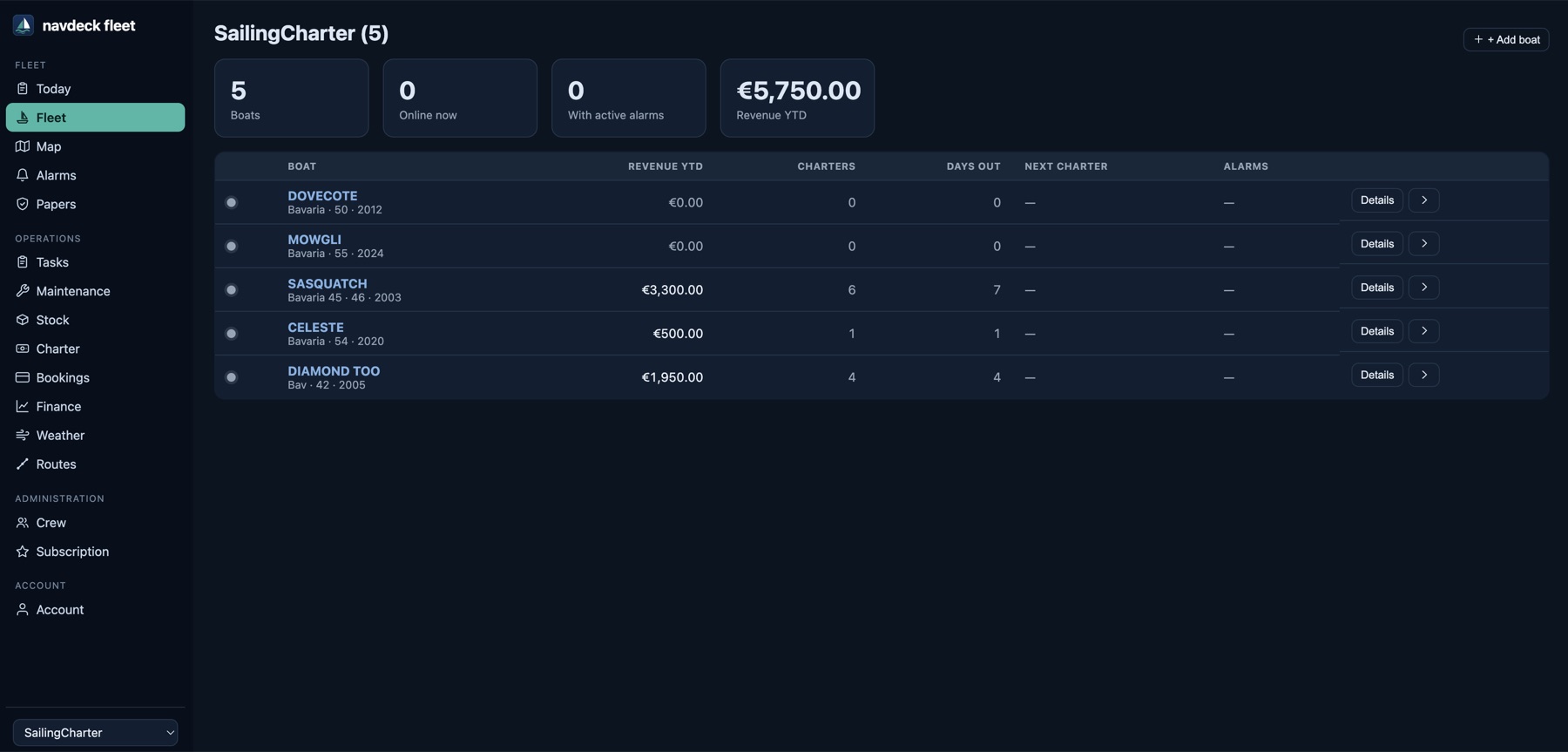
Revenue, charters and days out per hull — so you can see which boat earns its berth.
Società di charter, circoli nautici e gestori di yacht ottengono una mappa e una dashboard live di tutta la flotta — posizione, allarmi, batterie — più una vera economia del charter: viaggi come ricavi, spese come costi, profitto per barca. Gli armatori concedono l'accesso alla tua organizzazione; tu non gestisci mai le loro credenziali.
Revenue, charters and days out per hull — so you can see which boat earns its berth.
Ogni barca live su un'unica mappa con evidenziazione degli allarmi — clicca un marcatore per lo stato completo.
Una tabella di stato su tutte le barche che possiedi o gestisci, con chip di metriche espandibili per ogni barca — una richiesta per aggiornamento, non una per barca.
Un'unica vista allarmi su tutte le barche gestite — scopri il problema della pompa di sentina prima che ti chiami l'armatore.
Registra ogni viaggio di charter — date, cliente, tariffa — e i ricavi della barca si costruiscono da soli.
Carburante, approvvigionamento, pulizie, manutenzione, ormeggio, equipaggio — categorizzati, per viaggio o per barca.
Profitto e margine per barca e per categoria di spesa, così sai davvero quale barca genera guadagno.
Il piano di manutenzione di ogni barca raggruppato e segnalato per scadenza in un unico posto — incluse le barche che una flotta gestisce solo, senza possederle.
I promemoria basati sull'utilizzo seguono la telemetria reale, non una stima a calendario.
Registra il lavoro, azzera il conto alla rovescia, vai avanti.
Un armatore condivide la propria barca con la tua organizzazione al livello di visibilità che scelgono — e può revocarlo in qualsiasi momento.
I livelli di visibilità (sola posizione → operativo → storico completo) sono verificati a ogni singola lettura, non solo nell'interfaccia.
Una flotta che possiede barche direttamente le gestisce nello stesso modo, affiancate a quelle condivise dagli armatori.
Your logo, your photo, your colour — and a link you can put in a social post. The customer picks a date and a departure without an account.
Ask for a percentage or a fixed amount to hold the boat, the rest on the day. The season's revenue still counts the full fee — a deposit is cash timing, not income.
Publish a charter that runs on whichever boat is free and big enough for the party. The customer sees which boat they would get; you stop maintaining one listing per hull.
Card payments go to your own Stripe account, never through ours. Refunds, balance links and payment checks are in the portal.
Branded, with the boat, the meeting point, an arrive-by time, what to bring, your cancellation policy and a calendar invite attached.
A booking nobody has replied to is a lost sale, not a late one — so it sits on the Today board until somebody deals with it.
Wind, gusts, waves and the exposed sector, per boat, against that charter's own hours. Two levels: warn the customer, or cancel.
No position, no forecast that far out, or a weather service that did not reply — all say so plainly. A charter we could not assess never shows green.
Roster skippers and hosts per charter, including freelancers with no account, and get hours and days per person per month — the number a pay run actually needs.
The twenty minutes between one customer leaving and the next arriving, on screen instead of on a printed sheet. A blocking line refuses sign-off and says which one.
Insurance, registration and survey across the whole fleet, sorted by what expires next — and boats with no dated papers at all listed separately, never quietly counted as fine.
Firing alarms, maintenance actually due, today's turnarounds, boats gone quiet and unanswered booking requests — one list, worst first, each row naming a boat and an action.
Tanks, power flow, engine and a compass rose per boat — the same panels myboat draws, so a manager and an owner are looking at the same thing.
The whole fleet's tracks on one map for a chosen window. Did that boat go where the booking said it would?
AIS targets near your boats, assembled from the platform's own feeds — you own no receiver and send nothing. Your own antenna, if you have one, simply makes it sharper.
A hull with no box aboard still appears on the map if AIS has seen her — marked as located rather than tracked, with the age of the fix written on the label.
The boat's manuals, papers and every job ever done on her, filed against the hull rather than against your company.
What is on the shelf and what still has to be done, per boat, so the turnaround is not a memory exercise.
No. La maggior parte delle flotte gestisce un mix — alcune barche di proprietà diretta, altre condivise da armatori che concedono una relazione di tipo "gestore". Entrambe hanno lo stesso aspetto e funzionano allo stesso modo nella dashboard.
Un armatore che usa l'app gratuita myboat condivide la propria barca con l'ID della tua organizzazione e scegli un livello di visibilità — dalla sola posizione allo storico completo della telemetria. Non vedi mai il suo login, e può revocare l'accesso all'istante.
No — è incluso nel piano Fleet. Registra i ricavi e i costi di un viaggio man mano, e il report di profitto & margine per barca si costruisce da solo.
I dati della tua flotta e del charter si esportano in qualsiasi momento. Crediamo che andarsene debba essere facile — è ciò che rende significativo restare.
Gratis per aggiungere le tue barche. Accogliamo personalmente ogni flotta — scrivici in qualsiasi momento.